
AI has moved at extraordinary speed over the past two years. Generative AI is now part of everyday work, helping people draft documents, analyse data, summarise meetings and accelerate routine tasks. Yet for all the momentum, most organisations have not fundamentally changed how they are structured or how work flows across teams. Productivity has improved at the individual level, but operating models, cost bases and management layers largely remain intact.
Agentic AI may be the first step beyond this phase.
Unlike traditional generative AI, which responds to prompts, agentic systems are designed to act. An agent can interpret goals, plan steps, interact with systems, take action, evaluate outcomes and adjust its behaviour. It does not simply generate content; it executes work across tools and platforms. This shift from assistance to autonomous action is significant.
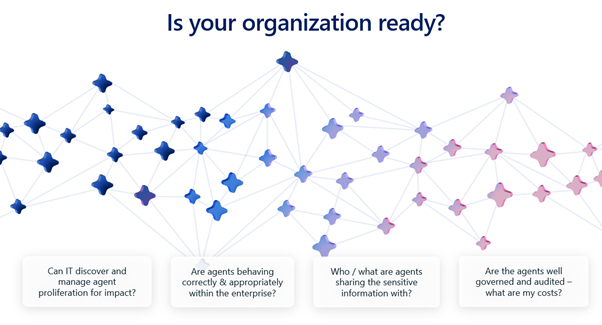
The scale of growth expected in this space is substantial. The International Data Corporate (IDC) predicts that by 2028 there could be 1.3 billion AI agents in operation worldwide. As organisations begin deploying agents at scale, the conversation moves quickly from capability to control. The real question becomes: how do you manage hundreds or thousands of digital workers operating across your environment?
Without structure, agents can proliferate rapidly. Different teams may build their own. Third-party agents may be introduced. Permissions can become overly broad. Visibility can be lost. The risk is not just technical; it is operational and regulatory. Organisations need a way to track, govern and secure agents without slowing innovation.
This is where Agent 365 is positioned.
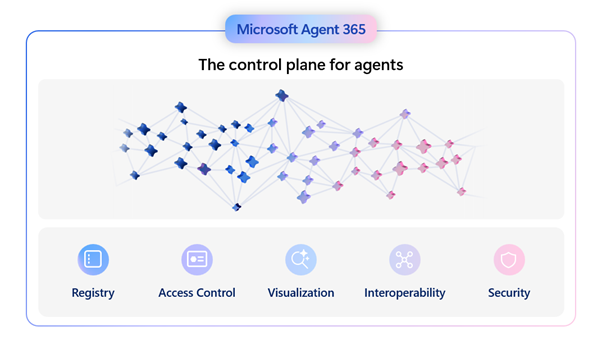
Agent 365 acts as a control plane for AI agents. It is designed to provide a consistent framework for deploying, managing and securing agents, whether they are built in-house, provided by Microsoft, or sourced from partners. The aim is straightforward: enable scale without sacrificing governance.
The Five Pillars Of Agent 365
Agent 365 is underpinned by five essential pillars that collectively ensure agents can be deployed, managed and scaled with confidence. These pillars serve as the foundation for a future-ready AI environment, supporting innovation while maintaining control, visibility and compliance across the enterprise.
- Registry – Every agent is assigned a unique Entra Agent ID, treating it as a managed digital identity rather than a background process. This creates a single, organisation-wide view of all agents in use. By maintaining a central registry, businesses can prevent uncontrolled growth and ensure every agent is known, classified and governed.
- Access control – Agents are granted permissions based on least privilege and Zero Trust principles. They access only the data and systems required to complete their tasks. Administrators can define guardrails around who is allowed to create, deploy and manage agents, ensuring clear ownership and accountability.
- Visualisation – As adoption grows, leaders need clarity on how agents are being used and what impact they are having. Agent 365 provides dashboards, telemetry and real-time insights into deployment, usage patterns and system interactions. This visibility reduces blind spots and supports informed decision-making.
- Interoperability – Agents are most powerful when they can operate across Microsoft 365 and connected business platforms. Agent 365 enables secure communication and coordination between agents and enterprise applications, allowing them to automate real workflows rather than isolated tasks. This includes interacting with tools such as SharePoint, Dynamics 365 and core productivity applications while maintaining policy enforcement.
- Security – Agents are protected using the same enterprise-grade identity, security and compliance model applied to users and applications. Integration with Microsoft Purview enables data protection policies and auditing of agent activity. Integration with Microsoft Defender allows organisations to detect, investigate and respond to threats targeting agents in real time. This unified approach ensures that as agent usage increases, security posture remains consistent.
Agentic AI introduces a new operational layer inside the enterprise. It creates opportunity, but it also expands the attack surface and governance burden. Managing agent sprawl, controlling permissions, protecting sensitive data and defending against AI-specific threats are no longer optional considerations; they are foundational requirements.
Agent 365 is designed to meet that need. It provides the oversight and control required to scale AI agents confidently, ensuring they operate as trusted, governed digital workers rather than unmanaged automation.
As organisations move from experimentation to deployment, the ability to manage agents at scale will define success. Agent 365 forms part of the Frontier Programme and represents Microsoft’s approach to enabling secure, enterprise-ready agentic AI.